This is a page about what I think of piracy, and why I don't think the subject is quite as simple as "piracy is theft".
The biggest thing that bothers me about general arguments against piracy is the phrase "piracy is theft".
Nope! It isn't.
If I steal your segway, you (obviously) no longer have it. If I copy a file from your computer, you still have your file. I have another copy, but yours didn't go anywhere.
That doesn't automatically mean that every act of copying is legal. It just means that copying something digital is compleeeetely different from taking a physical thing away from someone.
This is very important when talking about digital media, because making another copy is usually effortless. A CD, a book, a car, and a computer file are not the same kind of object, so we can't pretend they are.
Sometimes, probably. But I don't think it is reasonable to assume that every person who downloads something illegally would otherwise have bought it.
Suppose there are 1,000 unauthorized downloads of some game. It is tempting to say "that's 1,000 lost sales", but that only works if all 1,000 people were actually going to buy it. Some of them may not have had the money. Some may have wanted to try it first. Some may have been unable to buy it where they live. Some may simply never have been customers at all.

That is one reason I don't find such lost sale arguments particularly convincing.
There are also cases where piracy is the easiest way to get access to something at all.
Software used to have demos, shareware versions, trial periods, and other ways of helping you figure out if you want to try said software. Those things seem to have become less common, while software has often become more expensive, more restrictive, and more dependent on online services.
The same thing happens with older games, films, television, music, and other media. Something can be completely legitimate to own, yet be extremely difficult to buy.
At this point, I think it's reasonable to ask what the point of the system is. If somebody is willing to pay for something yet at the same time cannot actually obtain it, telling them that they should simply go without is not a really satisfying answer.
Another thing that usually gets lost in most of these discussions is the difference between the people who make something and the company selling it.
I always like supporting creators when I can. In fact, that is one of the reasons I prefer buying music directly and physical media to support independent creators.
But... Supporting creators doesn't automatically mean that I have to agree with every decision a corporation makes.
A company can lock something behind a crappy (dis)service, attach useless restrictions to it, remove something that people love and already paid for, or make it difficult to impossible to obtain without another subscription. (hmm, I reaaally wonder if this is already happening...) Obviously, consumers should not be forced to pretend that they like these practices.
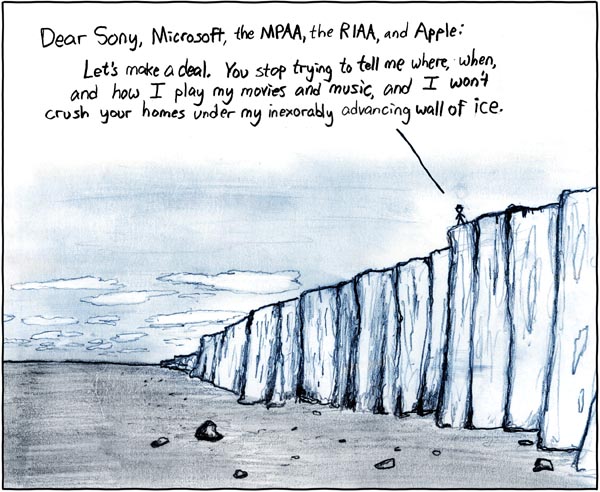
Sometimes people simply don't want to give a particular corporation their money, especially if there are free alternatives (either gratis or libre).
Music is a bit of an interesting case for me because I care quite a lot about actually owning the music I listen to.
Whenever possible, I'd rather have a CD, vinyl record, cassette, or a simple digital copy to maintain myself. I like being able to back it up, put it on another device, own high quality audio, and most of all, not wonder if it will disapear off the internet anytime in the future.
That is also why I don't really like the idea of paying indefinitely to rent access to music.

I don't have much of a problem with people pirating music. But, If the music is available on CD or another physical format, that's great. If it's available on Bandcamp or somewhere similar, that's almost as good. Especially when we are talking about less known artists, they are deserving of money and support.
And, rather importantly, I don't think artists are helped by making their music impossible to find. Ironically, piracy can spread people's work the best.
Over here, I am a bit more sympathetic to piracy.
Streaming was once sold as a simpler alternative to piracy, and for a while it was.
Now there are so many different platoforms to choose from. Now, if you want to watching something you have figure out which company currently owns it, which subscription you need, which country you are in. Untill you realise that your (dis)service doesn't host local basketball and football games, and you have to pay for two more (dis)services, untill they decide drop support, and decide to host mainly golf matches.
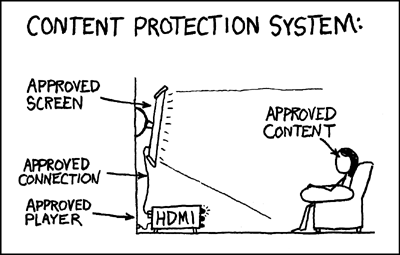
It is a very tough case for sports, since games are streamed live, you have no choice but to depend on something to watch them. Although there are kinder platforms, especially through the internet. As for movies, they can be very hard to find on streaming platforms, yet extremely easy to find on piracy sites, this is because streaming platforms drop titles based on what they think users want to watch
With that in mind, it makes a lot more sense to download a film, and watch it offline, than to pay for several subscriptions in order to find a film.
Fonts are a bit of a confusing case.
Some fonts are absurdly expensive for what most people want to do with them, especially if all you want is to use one on your own computer.
At the same time, fonts are designed by people, and those people deserve to be able to make a living too.
For personal local use, I wouldn't be bothered at all to see somebody use a pirated font. Just like music, people should not chide you for listening to a song, singing along, or remaking them. It is a similar case for fonts, they are just computer drawings, get real! It's kind of stupid, I can see it with my own two eyes, will the very act of doodling such fonts with my eyes closed be considered a copyright crime? Apparently yes. All your fonts are belong to us! Since copyright exists, you can't use said fonts commercially or publically, but there should be plenty of free alternatives.
Games are where my opinion depends most on who made the game.
Indie games: I don't pirate them.
Small developers generally have far less money and far less room for lost sales. If an independent developer makes something I enjoy, I would greatly enjoy actually buying their product, and giving them support.
AA games: I would pirate one as a sort of unofficial demo, and then buy it if I like it.
AAA games: Much the same applies, although I am less concerned about a giant publisher losing one sale than I am about a small publisher losing one.
There are also publishers I simply don't want to support. In that case, I may decide not to buy the game at all.
But, I think there is an important line here: We shouldn't pirate indie games just because they are temporarily exclusive to a platform we dislike.
If an indie developer would accept an offer from Epic or another publisher, I don't think the developer should be punished for trying to keep their business alive.
One of the biggest problems I have with discussions about piracy is that people usually treat every form of copying as though it has exactly the same consequences.
Copying a film that cannot be purchased anywhere is one situation. Downloading a game from a tiny independent developer who depends on sales to survive is different (and completely evil).
Copying an old piece of software that hasn't been sold in twenty years is different (has different moral reasons).
Lastly, downloading something that you were already planning to buy is different again (arguably no "damage" to anyone, no lost sale).
These situations could all involve unauthorized copies, but that doesn't mean the ethical question is the same for all cases.
I think piracy, for how I use it, is great. But notice how I worded it that way. As I showed before, there are different ways that piracy works, and how (or why) someone would pirate. As long as you aren't being an ass to indie creators, letting the man get you down (or more realistically, get your bank account down), I don't think you're doing anything wrong, you are just doing things that our freedoms ought to permit you to do, even though many rules have been distorted and bent by corporations to make us believe otherwise.
I think some important questions are; what is being copied, who made it, whether it is realistically available to buy, what the money actually supports, and whether the person making the copy would otherwise have bought it.
Once again, I also think people should be free to make their own decisions about what they support.
If somebody wants to buy a CD and support an artist, right on. If somebody wants to buy an indie game and support its developer, great. If somebody refuses to give money to a company they strongly object to, that's also okay. If someone wants something, like a movie, or song, that is very hard to find, or old, that's okay too, It is safe to say that your download will not harm anyone.
But, if you ever wanna get started, check out these links, Arr!
If you want to pirate websites, use a browser with a good content blocker such as Firefox with uBlock Origin. These sites can contain third-party advertising and pop-ups, so be careful where you click.
Most importantly, have a good idea of why you want to start pirating before you do it, and make sure you understand what you're getting into.
Either way, it's never too late the start, piracy is making a big comeback, and it's never to late to learn where to start!
If you don't like streaming (dis)services like me, check out this guide I made to host your own home media server.